
Elbow pain
Tennis and golfer's elbow. Treatment in Rijswijk, near The Hague

Sound familiar?
- Is your elbow getting in the way of your daily activities?
- For example, does it hurt when you lift, squeeze, use a screwdriver or open a bottle?
- Do you feel your elbow doesn't fully straighten or bend anymore?
- Maybe that elbow pain makes it hard to play sport or work?
- Can't you manage to stay pain-free on your own yet?
Could this be done differently?
- Would you like to do your daily activities without pain again?
- Want to play sport completely pain-free again?
- What would it be like to do everything again?
- Want to see results right away?

Zorgkaart Nederland

Really good experience with this physiotherapist. He takes his time with you and listens well. Every visit he asks how it’s going and whether there’s any improvement. Thanks to the exercises I got as homework, I’m now almost rid of the pain. I’d recommend this physiotherapist to everyone!
Written by Daan Lansdorp, physiotherapist and owner of FysioGrow.
Does your elbow hurt when you lift something, type on a keyboard, open a jar, or after a game of tennis or squash? Is it holding you back at work, in sport or in the things you love doing most? Imagine moving again without constantly thinking about your elbow.
I’d like to explain where elbow pain can come from and what you can do about it. Read on to find out more!
Symptoms of elbow pain
Elbow problems can show up in different ways. You’ll read more about that below. Besides the pain itself, you may have these symptoms:
- Pain on the outside of the elbow (often with tennis elbow)
- Pain on the inside of the elbow (often with golfer’s elbow)
- Pain that spreads to the forearm, wrist or fingers
- Loss of strength in the hand or forearm when gripping, lifting or squeezing
- Stiffness in the morning or after resting the arm for a long time
- Difficulty fully straightening or bending the elbow
- Tingling or numbness in the fingers (especially the little and ring finger with nerve problems)
- A swelling or warm area at the tip of the elbow
Causes of elbow pain
Elbow pain can have different causes. Think of a sudden awkward movement, long-term overload at work or in sport, a fall on the arm, the wrong grip or technique in sport, or irritation of a nerve that runs through the elbow. All of these send a pain signal to the central nervous system.
When the nervous system thinks it sees a problem or damage in the body, it tries to stop the problem from getting bigger. It does that by sending a pain signal. So that pain signal actually has a very good reason!
Instead of numbing the signal with a painkiller, we can also look for the cause of the problem. Because if you deal with that, there’s a good chance the pain goes away for good. Without having to depend on pain medication.
The most common causes of elbow pain:
- Tennis elbow (lateral epicondylitis). An irritation of the tendons on the outside of the elbow, often from overload when gripping, using a screwdriver or doing repetitive mouse and keyboard work. It also happens to people who never play tennis.
- Golfer’s elbow (medial epicondylitis). An irritation of the tendons on the inside of the elbow, often from throwing movements, forceful gripping or heavy lifting work.
- Olecranon bursitis. An inflammation of the bursa at the tip of the elbow, often with visible swelling and pain when you lean on the elbow.
- Cubital tunnel syndrome. Compression of the nerve that runs along the inside of the elbow, often with tingling in the little and ring finger and loss of strength in the hand.
- Triceps or biceps tendinopathy. An irritation where the triceps (back) or biceps (front) attaches to the elbow, usually from overload in strength training.
- Posterior impingement. Pinching at the back of the joint when the elbow is fully straightened, often in throwing athletes and bodybuilders.
- Pronator teres syndrome. Compression of the median nerve in the forearm, with pain on the inside of the elbow and loss of function in the thumb, index and middle finger.
- Compensation from the neck, shoulder or wrist. Reduced stability higher up or lower down the chain often leads to ongoing overload of the tendons around the elbow.
There are more possible causes, and we find those out during the assessment. For more general pain you feel elsewhere in the body, you can read more there.
Sometimes the pain stays, even though the body seems to have healed the acute cause. There can be different reasons for this. The body may have developed compensation strategies so you can keep moving. In the longer run, that compensating can cause overload in other parts of the body, often the shoulder, neck or wrist. After an elbow episode, muscles can also keep tensing up to protect it. That protective tension can cause stiffness and pain by itself, even when the original cause is long gone.
Stress and tension can play a part too. High stress levels often raise the tone of the forearm muscles, and people in pain tend to grip harder without noticing while they work. That adds to the overload on the tendons around the elbow. So in the assessment we look at the bigger picture, not just at the elbow itself.
Treatment of elbow pain
Once we’ve found out what’s causing your pain, we put together a treatment plan. First we try to get all the muscle tissue, connective tissue and joints working properly again, each on its own.
Sometimes there’s still too much tension in the forearm muscles or the connective tissue around the elbow, and that needs to be treated first. We do this on the treatment table. Once the tissue has been treated, you can produce more strength straight away and your mobility improves.
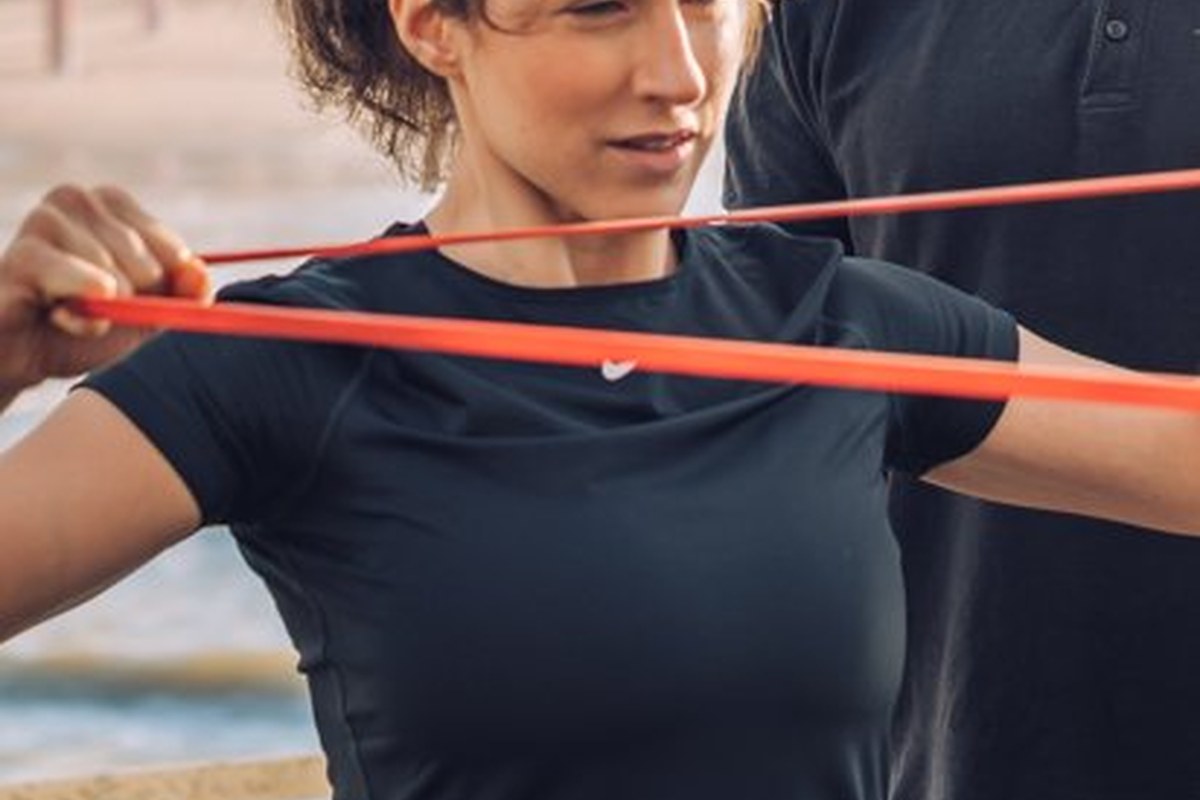
With tennis elbow and golfer’s elbow, targeted exercise therapy is the most important part of the treatment. Specifically, we work with a measured load on the tendon that slowly gets heavier. This principle (heavy slow resistance training) makes the tendon adapt and get stronger, instead of just resting and hoping the pain goes away by itself.
We also teach the body to get all the tissues working together properly again. Every part has to do its job at the right moment. For example: with every movement where you grab or lift something, your shoulder blade should act as a stable base. If your shoulder blade is poorly controlled and gives way, the forearm has to produce all the force on its own. That seems harmless for one movement, but over hundreds of grips a day it becomes constant overload of the tendons around the elbow. You feel the pain in the elbow, while the cause sits higher up the chain.
Because the exercise programme teaches the body to spread force evenly through the whole chain again, we tackle the cause of the pain!
The number of treatments depends on the problem. Tennis elbow or golfer’s elbow often responds gradually to a well-structured loading programme, with clear improvement within eight to twelve weeks and full recovery in three to six months. Olecranon bursitis goes faster. With nerve compression such as cubital tunnel syndrome, the course depends on how long the nerve has been under pressure and what changes are possible at work or in your sleeping position.
Want to get rid of your pain? Have a proper assessment of where it comes from? Move better, longer and more freely again? Book an appointment now and come and see us at FysioGrow in Rijswijk, near The Hague! If you’d like more information first, click the WhatsApp icon. I’m happy to answer your questions.
Frequently asked questions about elbow pain
When should I see a physiotherapist for elbow pain?
When elbow pain lasts longer than two weeks, when it keeps coming back, when you lose strength in your hand, or when you have tingling that spreads to your fingers. If the pain limits your work or sport, booking an appointment is a good idea too. After an acute injury with a visible deformity, if you can’t bend or straighten the elbow, or if the pain comes with a fever, see your GP straight away.
How long does tennis elbow last?
Without treatment, tennis elbow often heals on its own within six to twelve months. But that’s a long time to walk around with it. With targeted exercise therapy we see clear improvement within eight to twelve weeks, and full recovery usually within three to six months. The tendon has to learn to handle load again, and that takes gradual build-up, not just rest.
Does a tennis elbow brace help?
A brace can ease the symptoms for a while by shifting the pull on the tendon attachment, but it doesn’t fix the underlying cause. Wearing it during specific loads (like a full day of heavy DIY) can make sense. Wearing it all the time often weakens the forearm muscles and delays the real recovery. Exercise therapy is the first choice.
What can I do myself about elbow pain?
Adjust the load for a while: avoid repetitive gripping that triggers the pain and take a look at the ergonomics of your workspace. An RSI-friendly mouse, a height-adjustable desk and regular micro-breaks all help. Keeping the arm completely still is usually not the answer: a light, measured load on the tendon speeds up recovery. If there’s a lot of swelling around the tip of the elbow, cooling it for a short time can help.
Do I have to stop sport or work with tennis elbow?
Not necessarily. With severe pain you may need a short rest and a change in technique or grip, but stopping completely often slows recovery down. During treatment we can look at what load the tendon handles well right now and which changes in technique, grip or ergonomics take away the overload, so you can keep doing your sport in an adapted form.
When is surgery needed?
With tennis elbow and golfer’s elbow, surgery isn’t needed in most cases, as long as you properly complete the course of exercise therapy and load adjustment. Only when good conservative treatment has failed for six to twelve months is surgery sometimes considered. With severe cubital tunnel syndrome with lasting loss of function, or with some tendon ruptures, surgery may come up sooner.
Even though elbow pain seems local, the cause often lies higher up. A disturbed posture can cause problems in other areas at the same time, such as back pain.
Other common problems
Might also be relevant for you
The solution for your elbow pain!
Step by step we work towards being pain-free for good. We do this by combining the best hands-on techniques with a personalised exercise programme. We also look at changes you can make in your daily life to prevent the pain.